Music & Sound Awards: Talk to Jesse Zuretti (Juror for 2026)
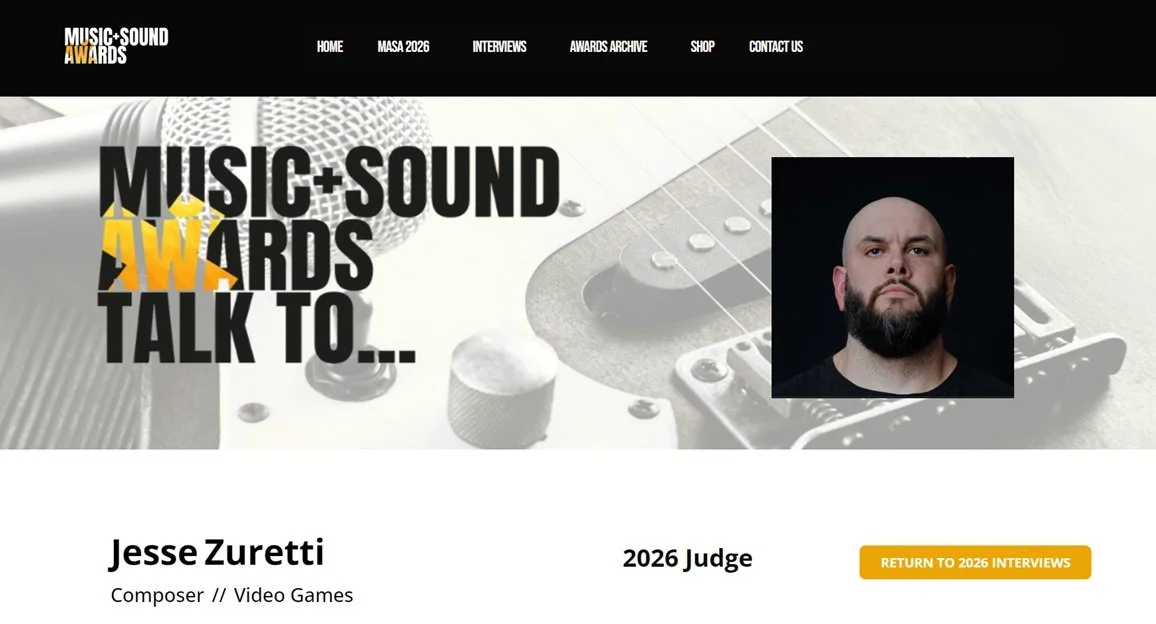
Jesse Zuretti - 2026 Judge - Composer // Video Games
From touring in a metal band to composing for Marvel and Riot Games, Jesse’s musical journey is anything but conventional. Uncompromising, deeply analytical, and fiercely dedicated to the integrity of the craft, he approaches video game soundtracks with the precision of a forensic profiler and the heart of a lifelong music devotee.
Most recently, Jesse has spent over three years helping shape the sonic identity of Riot Games’ highly anticipated fighting game, 2XKO. We took some time with him to discuss the immense pressure of reimagining iconic League of Legends lore, the vital importance of authenticity in heavy music, and why he believes composing is less of a career and more of a lifelong purpose…
June 2026
MASA: Can you tell us a little about your musical background and the path that led you into composing for games?
JESSE: I started making music in 2002, most notably starting with my own band in 2004 – which led to recording several albums, foreign and domestic touring, tri-state performances, and more. My music with my band eventually opened the door to composing for Marvel in 2018 completely out of the blue. After that, I was reached out to by bands, game studios, film studios, etc, and we’re here now! It seems I’ve been very fortunate to meet really great folks who can make music decisions for amazing productions based on original music I’ve written, and I couldn’t be happier and more grateful for that.
MASA: With experience across games, film, TV, and collaborations with bands and producers, how has that range shaped your musical identity?
JESSE: The medium has never been a factor for shaping my musical identity per se, but it’s absolutely helped me expand my mindset about how music plays a supporting role for bigger pictures consisting of loads of other people working their tails off. It’s really easy to think your role is the main character, but the story that’s being told is always number one.
Working on 2XKO for Riot Games has given me the ability to exercise certain music genre muscles that a lot of people don’t know me for that are truly my favourite styles to listen to and work at as a composer. For example, Teemo’s theme “Brighter Beatdown” is the stuff of my music dreams: it’s a blend of live orchestra, soloists, and whacky genres like jazz / hip-hop (Robert Glasper), acid funk (Jamiroquai), jazz fusion (Dirty Loops), funk fusion (Wayne Krantz, Oz Noy), soul (Stevie Wonder), bluegrass (Bela Fleck), and an almost classic Looney Tunes-esque narrative all the way through. I think my wife is about the only person who could’ve seen that theme coming.
That’s the beauty of working on a soundtrack with various characters and stages with broad backgrounds that need linear themes to make the player feel their powers.
MASA: What was the creative brief for 2XKO’s music and how did you approach building a sound that fits the game’s energy? Were there any specific sonic references, genres or textures that helped shape the 2XKO sound?
JESSE: Each character and stage had a brand new brief made as they were entered into the pipeline before launch. In-house principal composer for 2XKO, Michael Pitman, would make these beautiful presentations with references for each character. The lore of Runeterra is very precious for its fans, so this was a crucial element in the language building process early on. After working on it for a while (and eventually well over three years straight now), things become more obvious and understandable and less effort is needed to be deeply detailed about each brief. But the mainstay “reads” (as our audio director Eugene Kang called it) were (in so many words): hype, steady, flash.
MASA: What were the biggest creative and thematic challenges you faced when stepping into the world of this game?
JESSE: The most challenging aspect for me was making sure to respect the fans and players, because these characters and stages belong to them – not me. I needed to make sure that I was representing their favourite characters in a way that made sense to them, but I also needed to be entirely new and unique compared to their League of Legends themes. Which, by the way, are some of the most elite pieces of music I’ve heard in game audio history. Truly intimidating. I had to accept that this wasn’t meant to compete with those League themes, but to spin-off from them for a new experience for players.
MASA: You’ve mentioned wanting to represent the ‘DNA of metal’ authentically in games. What are the common mistakes you see when developers try to use metal or heavy music?
JESSE: This is a difficult question to answer quietly (and briefly), because there’s a lot of emotional and cultural context behind it. Metal is a culture as much as it is a genre of music, and I think one of the biggest opportunities moving forward is continuing to involve musicians who were genuinely raised within that world and community itself. That’s one of the things I’ve always respected about Riot Games and their approach to music and artists. They care about finding the right people for the job, and a lot of the time that has meant involving actual metal musicians and bands in meaningful ways. I’d personally love to see more of that continue across games, film, and media, especially when it comes to the soundtracks themselves.
I know hundreds of incredibly capable, enthusiastic, reliable, and talented metal musicians who would give anything for the opportunity to contribute to a creative project, because for many of us this music was never just entertainment. It was identity, community, survival, passion, and self-expression. Historically, metal has often been misunderstood or misrepresented not just by mainstream culture, but across film, television, games, and media as well. Even though the genre has had massive global influence for decades, there were only relatively short periods of time where many metal musicians could sustainably make a living from it. A lot of people within the community still carry memories of being ridiculed, dismissed, underestimated, or treated like outsiders simply for loving this music and culture.
Because of that history, authenticity matters a lot within metal. People who spent years touring in vans, sleeping on floors, playing tiny rooms, sacrificing stability, and continuing to create despite limited opportunity tend to recognise very quickly when something comes from genuine understanding and appreciation versus when it only approaches the genre from a surface-level aesthetic perspective. And creatively, I think that authenticity matters too, because metal has never historically thrived by being safe or formulaic. Its identity has always been rooted in intensity, individuality, conviction, experimentation, and emotional honesty.
I say all of this with a lot of pride and optimism for where the genre is today. I’m genuinely happy that metal has become more accepted and that more musicians within the scene are finding opportunities to build sustainable creative careers. And I genuinely welcome anyone who wants to contribute to the genre’s continued growth and evolution. I just think there’s a lot of value in engaging with the culture itself, understanding its history, supporting its artists, and collaborating with people who have lived within that world for most of their lives, because audiences can genuinely feel the difference when that connection is real.
MASA: You’ve described your process as a form of ‘Method Acting’ for music – digging into the origins of a reference. Can you walk us through a specific character or theme where you had to ‘inhabit’ a genre to get it right?
JESSE: Ahri’s theme “Race Across Ionia” would be a perfect example. Her original theme for League of Legends was written by Yutaka Yamada, and it is absolutely flawless in every sense of the word. Aside from that being a huge challenge to live up to, I also had to compose something that felt “right” for a fighting game like 2XKO. The first thing I did was not listen to Yutaka’s theme until I sent in my first demo. In fact, I didn’t listen to any pre-existing themes (despite being asked to do so) because I didn’t want to get too close to the original. The themes that already existed are sacred – not just to the composers, but also the players. And since that worked out early on in the 3 years I’ve worked on the OST for 2XKO, I continued that onward. This is almost the first step for getting into the right mindset to “methodically” adapt to the brief.
Next step was to do a full profile on Ahri’s character, as I’ve always done since I started composing as almost a habit from my studies in Forensic Profiling from my college years. This always comes in handy when it comes to translating things almost like a real psychological subject, using everything available including dialogue, body language, visual design, relationships, lore, symbolism, gameplay behaviour, and even the musical language surrounding the character to understand who they actually are beneath the surface. The goal is not just identifying obvious personality traits, but understanding the emotional patterns, contradictions, insecurities, motivations, coping mechanisms, and “lived” experiences driving the character internally, then translating those ideas into a cohesive emotional identity.
That also means examining the mythology, cultural influences, narrative themes, sound world, instrumentation choices, harmonic language, and overall creative direction surrounding the character to understand why people emotionally connect with them so strongly in the first place. At its core, forensic character profiling is really about uncovering the deeper human psychology hidden inside fictional characters and translating that into storytelling, visual identity, and music that genuinely feels emotionally truthful.
“Race Across Ionia” feels less like a traditional character theme and more like a psychological snapshot of Ahri in motion. From a forensic profiling perspective, the music reflects a personality built around emotional “contradiction”: elegance (her allure) and danger (her powers), confidence and loneliness (her background), curiosity and restraint, all constantly shifting beneath the surface without ever fully settling.
A huge part of that emotional language comes from my love of anime soundtracks, especially composers like Joe Hisaishi and Kevin Penkin, where their melodies, atmospheres, harmonies, and emotional sincerities are often treated as the true center of the storytelling experience. Rather than portraying Ahri as simply seductive or mystical, the piece approaches her more like a deeply human character beneath the mythology, using flowing melodic phrasing, movement, harmonic color, and emotional pacing to frame her as someone searching for identity, freedom, understanding, and belonging all at the same time.
MASA: You’ve mentioned the ‘undying devotion’ this craft requires. For you, is that devotion an innate drive that you simply have to honour – and what happens to the music when a creator loses that fire?
JESSE: I truly believe the coding required for this craft to be a full-time job is wrapped up in internal honesty, and the connection between action and introspection. Undying devotion shouldn’t have to be taught to those pursuing this art form as a career – no self-help books, no pep talks, no doubts – just endless work and commitment. Nothing against anyone who has found those things helpful, but maybe their answers would be different than mine. My answer is wrapped up entirely in my journey, which is the one I know best – and I’ve never for a second stopped caring about music (as a whole) for even a second since I started loving music as a toddler.
I’ve never seen music as a chance to make money, an opportunity to ascend some specific height of accomplishment, or to inflate ego. This is my purpose on Earth, and committing to that – understanding that – makes this career feel less like a job and more of a gift.
If this job ever feels like a chore to anyone, pass the gig on to someone hungrier and more excited. We owe it to the productions, the people, the players, and music as an art form and community, to make sure the best person is doing each job. People will often get caught up trying to make ends meet by taking on any gig that pops up without realising how little they’re invested in the project – they just want the financial gaps to be smaller. It happens to the best of us, but it should never be an opportunity to underhand music. I implore anyone reading this to really take a look in the mirror as often as possible, and figure out why they’re doing this if it ever feels like a chore. If you love music – TRULY love music – anyone who respects and trusts you enough to write music for their production deserves your best, not what you’re willing to give when you’re not “in it”.
So my answer is: maybe reset your career pursuits if it’s becoming a chore. Or pass the gig along to the next generation. There’s no shame in pivoting to a different role in music if the actual fun part starts to suck for you.
MASA: And lastly, what will you be looking for when judging this year’s Music+Sound Awards??
JESSE: Uncommon creativity – words I utter to an obnoxious extent. The more original and head-tilting (in a good way) the work, the likelier you are to check the right boxes for me. I’m not interested in the next version of so-and-so composer/producer, I’m looking for the next person who inspires others. And my advice to folks to accomplish this is to listen to as many genres, bands, artists, and composers as humanly possible so you can build the best and most adaptable vocabulary for finding your own voice.
MASA: A massive thank you, Jesse, for taking the time to share such incredibly candid and thoughtful insights with us. Your artistic intensity makes it entirely clear why your work resonates so deeply with players. We are absolutely thrilled to have your sharp ear and unique perspective on our judging panel for this year’s Music+Sound Awards!